On the Truck
Cable Work We Finish Most Days
Cables, drums and the hardware that usually needs looking at once one has let go.
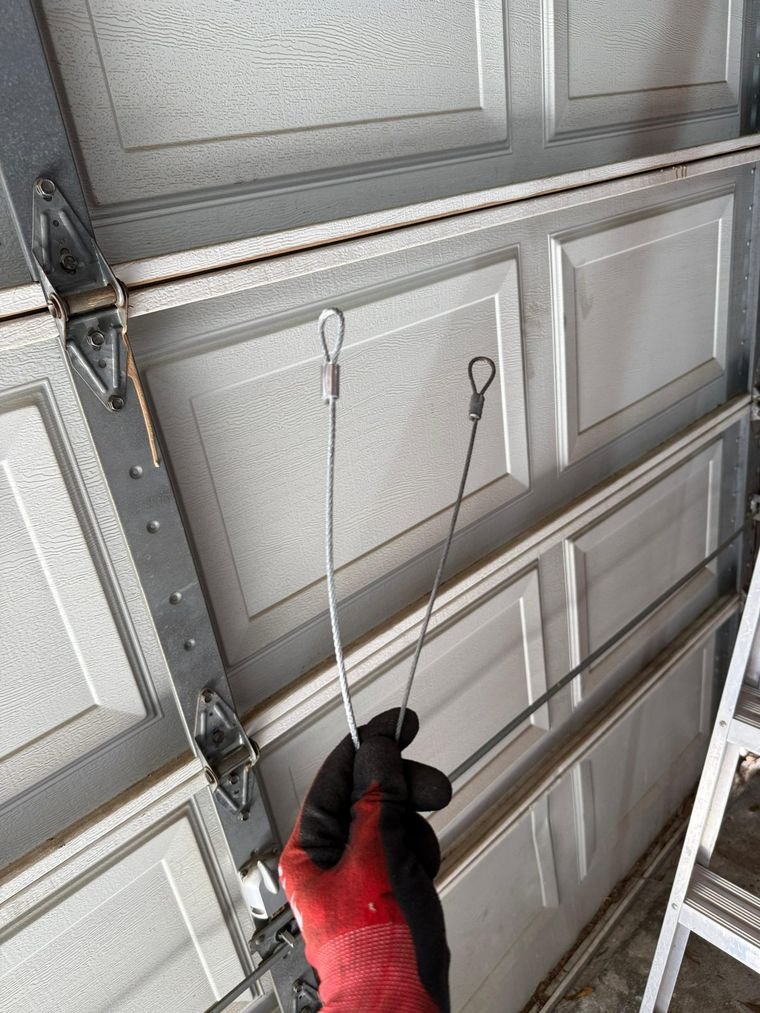
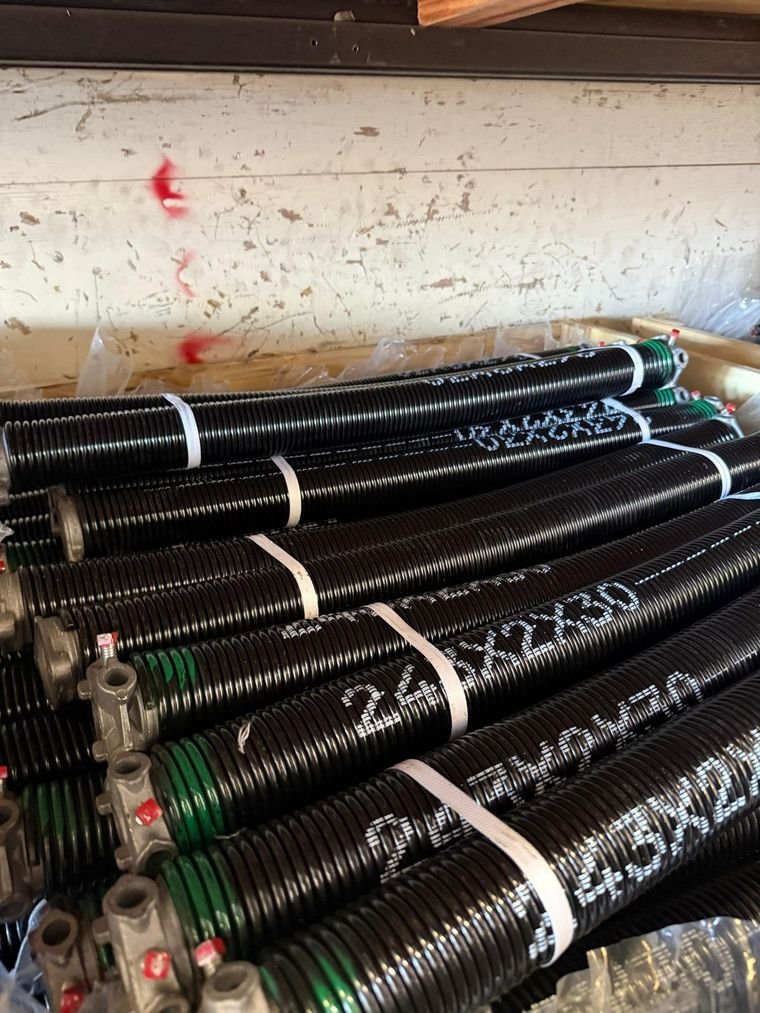
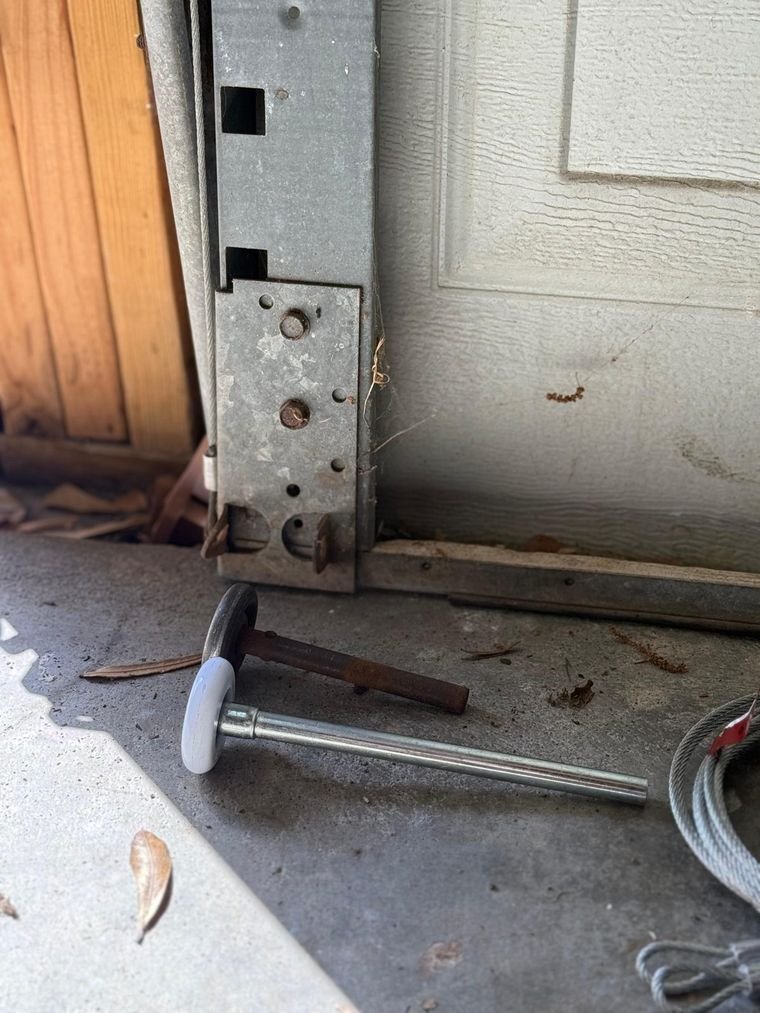
A frayed or snapped lift cable leaves the door hanging crooked and the spring tension going somewhere it was never meant to go. We replace cables in pairs, re-seat them on the drums, set both sides even and re-balance the door — same day, 24 hours a day.
Cables are the quiet half of the counterbalance system, and they fail in a small number of very recognisable ways.
The clearest sign there is. With one cable no longer pulling, that side of the door drops and the whole thing hangs at an angle in the track. It usually looks worse than it is — provided nobody has kept running the opener.
Look at the shaft above the opening. A cable that has jumped its drum ends up looped on the concrete or wound into a bird's nest around the shaft, and it will not go back on by hand while the springs are still wound.
Cables fray from the outside in. Run your eye — not your hand — up the last couple of feet above the bottom bracket, the part nearest the damp slab. Broken wires standing proud of the lay of the cable mean it is on borrowed time even if it has not parted yet.
One side kept climbing while the other did not, and the door has wedged itself in the tracks. Forcing it, in either direction, is what turns this into a bent-track and creased-section job.
A cable under load lets go with a sharp metallic snap rather than the gunshot bang of a torsion spring, and the corner it was carrying falls immediately. If that happened while somebody was standing in the doorway, that is exactly why we say do not stand under it.
When a spring lets go, the full weight of the door lands on cables that were never sized to hold it alone. It is very common for one to jump its drum in the same second. Assume both jobs, and mention the spring when you call so the right parts are on the truck.
Your springs carry the weight of the door. The cables are what connect that stored tension to the door itself — steel rope running from a bracket at each bottom corner, up the side of the opening, and onto a grooved drum at each end of the torsion shaft. As the springs unwind, the drums turn and wind the cables in, and the door comes up. As it closes, they pay back out under control.
The important consequence is that the cables are the only thing making the two sides of the door move together. Lose one and the door does not simply get heavier; it gets lopsided, and a lopsided sectional door in a steel track is what ends up off the track altogether. That is why the advice here is so blunt about not pressing the button again to see what happens.
Which system you have decides the parts, the labour and the safety procedure. You can tell them apart from the driveway in about five seconds:
| Torsion-system cables | Extension-system cables | |
|---|---|---|
| Where the spring is | On a steel shaft mounted horizontally above the opening | Stretched along the horizontal tracks, one down each side |
| What the cable does | Winds onto a grooved drum at each end of the shaft | Runs through a pulley system attached to the spring |
| How it usually fails | Frays at the bottom, or jumps the drum and unspools | Frays at the pulley, or the pulley itself seizes and cuts it |
| What else to check | Drum set screws, shaft bearings, bottom brackets | Pulleys, and whether a containment cable is fitted through the spring |
| Safety note | The shaft is under full spring tension — winding bars only | A spring with no containment cable becomes a projectile when it fails |
If your extension springs have no containment cable threaded through the middle, say so when you call. Fitting them is a small job we would much rather do on the same visit than come back for, and it is the difference between a spring that fails and a spring that flies across the garage.
Both cables have been on the door since the same day, have flexed over their drums exactly the same number of times, and have sat in the same humid Georgia garage. When one lets go, the other is not "the good one" — it is the same age, with the same corrosion, that happened not to fail first. The cable itself is a small part of the cost of the job next to getting a technician to the house, so fitting one and leaving its twin is a false economy that tends to book its own follow-up call within the year.
Threading a new cable on is about ten minutes of a job that should take rather longer. Here is what a technician actually does, and why the checks either side of the cable itself are the part that stops you calling again.
Cable work is priced on what the door needs, not on an hourly meter. We quote free over the phone once you describe the door, and on site you get a flat, written price before any work begins — the visit and the diagnosis are free whether or not you go ahead. These are the things that move the number:
| Factor | Why it changes the job |
|---|---|
| One cable or two | We fit pairs, but a door where only the cables are involved is a much smaller job than one where the cable was a symptom. |
| Torsion or extension | Different parts and a different procedure. Torsion work also involves the shaft, the drums and the bearings. |
| Whether a spring failed too | A broken spring that dumped the load onto the cables means both jobs, and the spring is the larger of the two. |
| Collateral damage | An unspooled cable frequently scores a drum, chews a bearing or pulls a roller out of the track on its way round. |
| Door size and weight | A 16 ft insulated double runs heavier cable and heavier hardware than an 8 ft uninsulated single. |
| Time of day | Emergency and overnight dispatch is available 24 hours; a scheduled daytime visit is the cheaper option if the door can safely wait. |
Whatever the door needs, you hear the number before we start — including if opening it up shows that the cable was the symptom and the spring was the cause.
Most cable calls across Dallas, GA and the surrounding metro are handled the same day you ring.
Which corner is low, whether there is slack cable on the floor, and whether the spring above the door has a gap in it. That is usually enough for a free phone quote and for the right parts to be on the truck.
An in-house technician, not a call-centre subcontractor, arriving with cables, drums, rollers and springs already on board.
You approve a written price before anything is touched. The door is re-balanced by hand and safety-tested before we leave.
A cable failure is often the second thing that went wrong rather than the first. These are the jobs that turn up alongside it.
The most common root cause. A spring letting go drops the whole weight of the door onto cables that were never meant to carry it alone.
See spring repair →One cable pulling and one not is how a door comes out of its tracks. If it has already jammed at an angle, this is the page you want.
See off-track repair →Car trapped behind a door hanging at an angle, or a door stuck open overnight? We're open 24 hours and a real person answers the phone.
See emergency service →Cables, drums and the hardware that usually needs looking at once one has let go.
Send your name, number and which corner is hanging low. We call back fast — usually within minutes during the day.
The questions we get asked on nearly every cable call across Paulding and Cobb County.
Based at 132 Azalea Lakes Dr in Dallas, GA, with technicians covering Paulding, Cobb, Douglas, Fulton, Cherokee and Bartow County.
The towns in red have a page of their own, with the drive time and the local housing stock — or see every town we cover.
Not on the list? Call and ask — we'll tell you straight away.
One call and a local technician is on the way with cables, drums and springs already on the truck. Same-day service across metro Atlanta, 24 hours a day.
Name, number, and what's wrong — we'll call you right back, usually within minutes.