On the Truck
Opener Work We Finish Most Days
Most openers we are called to do not need replacing. When one genuinely does, the install is finished the same visit.
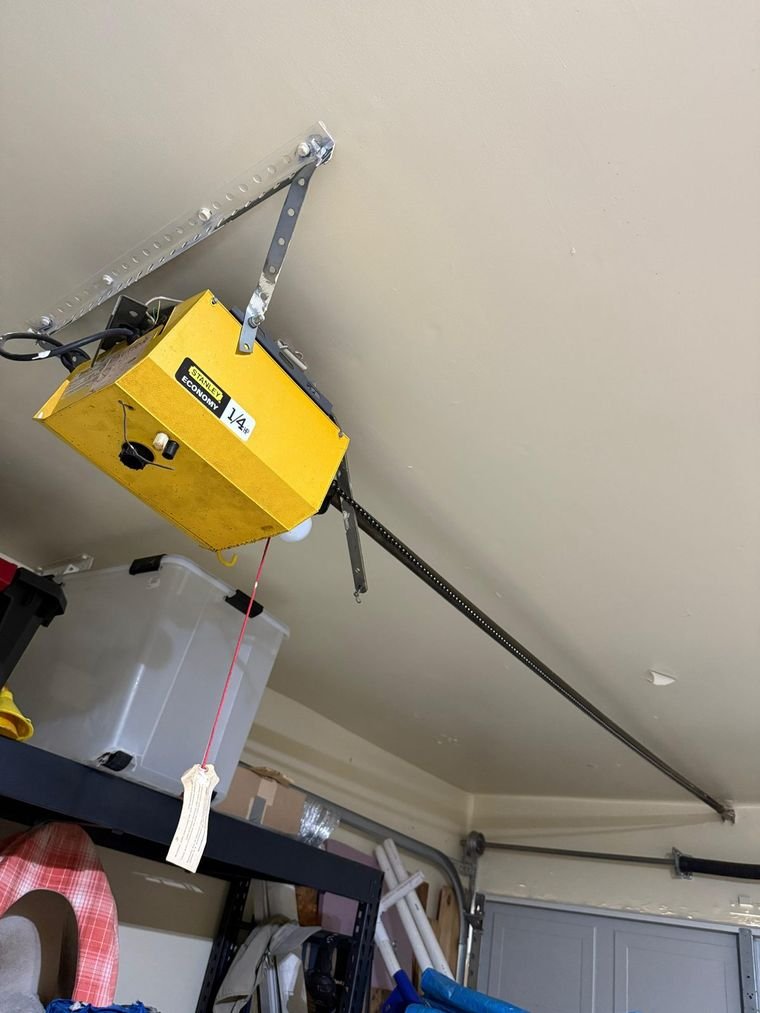
Humming, reversing off the floor, or completely dead? Half the openers we're called out to don't need replacing at all. We test the door, the sensors, the wiring and the board before anyone quotes you a new unit.
Half the openers we're called out to don't need replacing at all. Finding out which half you're in takes a technician about fifteen minutes.
Usually a stripped drive gear or a sheared trolley carriage — both repairable. Occasionally it's a failed capacitor. What it is not, in most cases, is a reason to buy a new unit.
Nine times out of ten this is the photo-eye safety sensors: knocked out of alignment, dusty, or with a spider web across the lens. One steady LED and one flickering LED is the giveaway. Our guide to garage door sensors walks through the checks worth doing yourself first.
That splits the problem neatly. Remote-only failures point at the logic board or a lost rolling code; wall-button-only failures usually point at the low-voltage wiring stapled through the garage. If it is only the remote, the remote troubleshooting guide covers the lock button, the battery and the LED-bulb interference problem before you call anyone.
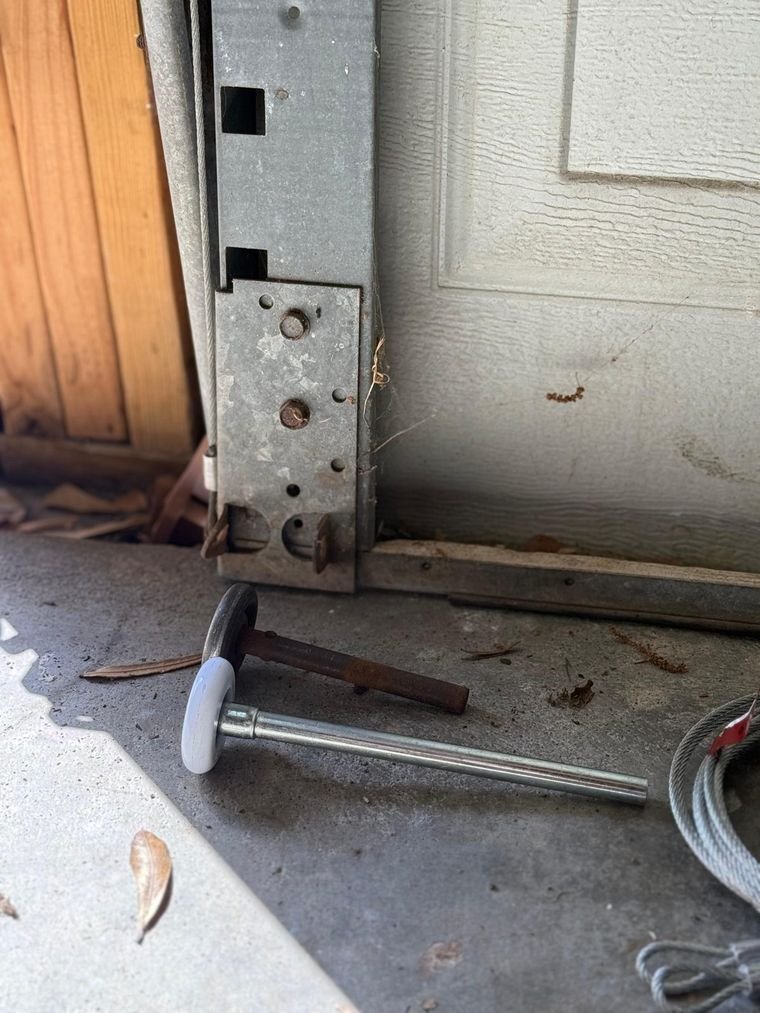
Worn rollers, a loose chain, a failing bearing or a drive gear on its way out. A chain drive that's suddenly noisy is worth catching before it jumps the sprocket.
Intermittent faults are usually heat, interference or a marginal connection. Georgia summers cook an attic-adjacent opener, and a board that works at 8 AM can quit at 4 PM.
Start with the obvious: the outlet, the breaker, and whether the wall lock button has been pressed. If those check out, it's the transformer or the logic board.
The quickest test costs nothing, as long as the door is fully closed and you have not heard a bang or seen a gap in the spring. Pull the red emergency release cord and lift the door about a foot. A healthy, balanced door moves with one hand and stays put wherever you leave it. If it's heavy, crooked, or won't stay up, lower it and stop: the fault is in the springs and cables, not the motor — and no amount of opener work will fix it. Never pull the release while the door is open.
Assuming the door checks out, the opener itself is a fairly simple machine with a small number of things that fail: the drive gear, the trolley, the logic board, the capacitor, the safety sensors and the wiring between them. We diagnose which one before quoting, which is why we can often repair a unit that another company has already condemned.
We'd rather fix your opener than sell you one. But there's a point where repair stops making sense, and we'll tell you honestly which side of it you're on:
| Situation | What we'd usually recommend |
|---|---|
| Under ~10 years old, single failed part | Repair. Gears, trolleys, sensors, capacitors and boards are all replaceable parts on a unit with plenty of life left. |
| Sensors misaligned or faulty | Repair. This is the most common opener call we get and one of the smallest jobs on the list. |
| Made before 1993 | Replace. Pre-1993 units predate the federal requirement for photo-eye safety sensors. If there are no sensors either side of your door, it should be replaced regardless of whether it still runs. |
| Fixed-code remote (no rolling code) | Replace. Older fixed-code openers can be captured and replayed. Modern rolling-code units change the code every use. |
| Repeated failures, or a discontinued board | Replace. Once parts are scarce, repairs start costing more than the unit is worth. |
| You want quiet, or you want your phone to open it | Replace. A belt-drive with a DC motor is dramatically quieter than an old chain drive — worth it if there's a bedroom over the garage. |
If you are replacing, the drive type matters more than the brand badge. This is the short version of the conversation we have on the driveway:
| Drive type | Noise | Best for |
|---|---|---|
| Chain drive | Loudest | Detached garages and workshops, where noise doesn't matter and durability and value do. |
| Belt drive | Quietest | Attached garages, and any home with a bedroom or living space directly above or beside the garage. |
| Screw drive | Middle | Fewer moving parts, but less tolerant of big temperature swings — a real consideration in an uninsulated Georgia garage. |
| Wall-mount (jackshaft) | Very quiet | Garages with high, low or obstructed ceilings, or where you want the ceiling clear for storage. Mounts beside the door instead of overhead. |
We repair and install LiftMaster, Chamberlain, Genie, Craftsman, Linear and Marantec openers, including MyQ setup and app pairing on the units that support it. If yours is an older or less common brand, describe the label on the motor housing when you call and we'll tell you honestly whether parts are still available before anyone drives out.
An opener that's been hung and plugged in is not the same as an opener that's been commissioned. Every install and repair we finish includes the following, because these are the steps that get skipped and then cause the callback:
We quote free over the phone from what you describe, and on site you get a flat, written price before any work starts — the visit and the diagnosis are free whether or not you go ahead. These are the variables:
| Factor | Why it changes the job |
|---|---|
| Repair vs. replacement | A sensor realignment and a full unit swap are different orders of magnitude. We diagnose before quoting, not after. |
| Which part failed | Gear kits, trolleys, capacitors, sensors and logic boards all sit at different price points. |
| Drive type & horsepower | Belt drives cost more than chain; a heavy insulated double door needs more motor than a single. |
| Wall-mount conversion | Jackshaft openers need a torsion shaft the unit can drive and clear side-room — more work than a like-for-like overhead swap. |
| Smart features | Built-in Wi-Fi, battery backup and camera modules are options, not defaults. We'll tell you which ones you'll actually use. |
| Wiring condition | Perished low-voltage wiring stapled through a hot Georgia attic is common on older installs and sometimes needs replacing. |
Same-day appointments across Dallas, GA, Paulding and Cobb County and the wider Atlanta metro.
Brand on the motor housing, roughly how old, and what happens when you press the button. That's usually enough for us to name the likely fault on the phone, free.
An in-house technician tests the door balance first, then the sensors, wiring, drive and board — so you find out what's actually broken before anyone talks about replacing it.
You get a flat written price for each realistic option and pick one. Then it's set up properly — limits, force, sensors, remotes — and safety-tested before we go.
Opener faults and door faults get mistaken for each other constantly. These are the two we're asked about most.
The most common cause of an opener that looks dead. If the door lifts a few inches and stops, it's almost certainly the spring — not the motor.
See spring repair →Door stuck open overnight, or your car shut in and you're due at work? We're open 24 hours and we prioritize calls where a home is left unsecured.
See emergency service →Replacing the door and the opener together is usually cheaper than doing them a year apart, and it lets us match the motor to the door's real weight. Free in-home estimate.
See installation →Most openers we are called to do not need replacing. When one genuinely does, the install is finished the same visit.
Brand, rough age, and what happens when you press the button. That's usually enough for us to name the fault before anyone drives out.
The opener questions we answer on the phone most days — free, before anyone is dispatched.
Based at 132 Azalea Lakes Dr in Dallas, GA, with technicians covering Paulding, Cobb, Douglas, Fulton, Cherokee and Bartow County.
The towns in red have a page of their own, with the drive time and the local housing stock — or see every town we cover.
Not on the list? Call and ask — we'll tell you straight away.
One call and a local technician is on the way. We'll tell you whether it's a twenty-minute fix or genuinely worth replacing — and you approve a flat price either way.
Name, number, and what's wrong — we'll call you right back, usually within minutes.