On the Truck
Spring Work We Finish Most Days
Broken torsion springs are the single most common call we take. The cable and roller work below is what usually comes with them.
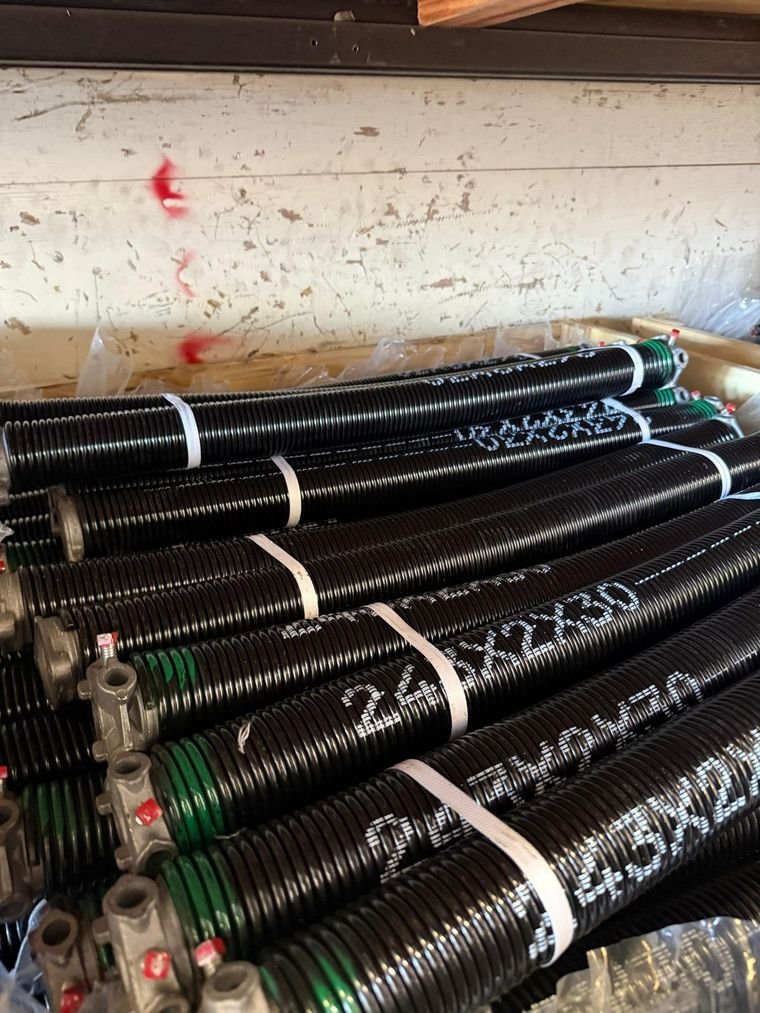
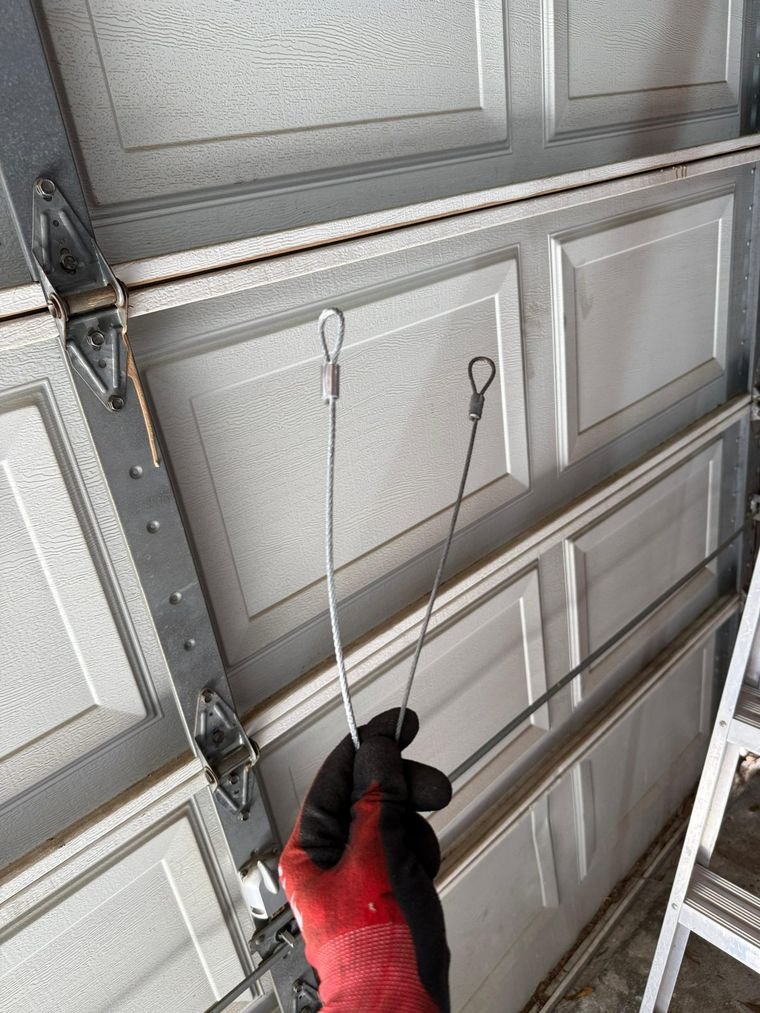
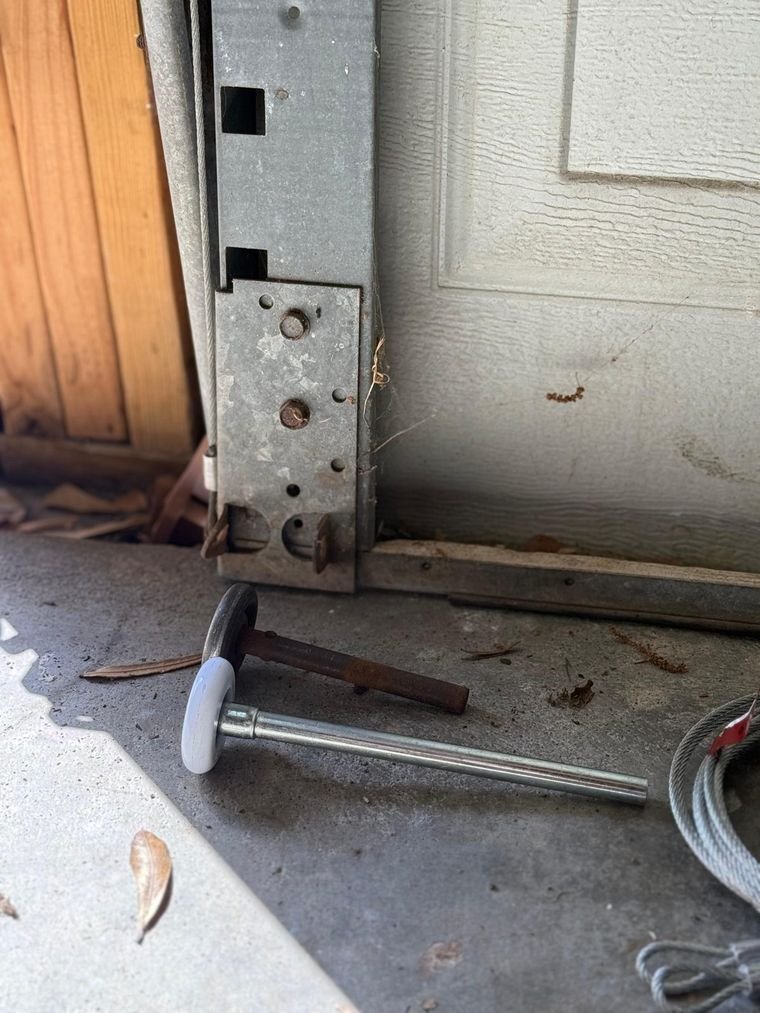
The bang you heard was a spring letting go, and your door is now several hundred pounds of dead weight. We replace torsion and extension springs in matched pairs, same day, with high-cycle galvanized steel — then re-balance and safety-test the whole door.
A broken spring is the single most common garage door failure we're called out for in Paulding and Cobb County. It almost always looks like one of these.
The opener strains, the door lifts a few inches, then it gives up or bounces back down. The motor is usually fine — it simply has nothing helping it carry the weight any more.
A torsion spring under full tension lets go with a loud metallic bang, often in the middle of the night when the garage cools. Plenty of our Dallas customers thought someone had hit the house.
Look at the bar above the door. If the tightly wound spring has a two-inch gap in it, that's a clean break — and the door is now several hundred pounds of dead weight.
One side lifts, the other lags. On an extension-spring door that usually means one spring has failed, or a lift cable has come off its pulley and the door is now pulling unevenly.
A door with a failed or badly weakened spring drops rather than descends. This is the dangerous one — do not stand under it, and keep children and pets out of the garage until it's fixed.
If the door is fully closed and you have disconnected it with the red release cord, a balanced door lifts with one hand and stays put. If it fights you or will not stay up, the spring is gone: lower it and stop there. If any other sign on this list applies, skip the test and leave the door alone.
Your garage door opener does not lift your door. The springs do. The opener only supplies the small push needed to start a balanced door moving and to hold it in place. That's why a broken spring looks like a dead opener: the motor is working exactly as designed, but you've just asked a half-horsepower unit to deadlift a few hundred pounds of steel.
It's also why replacing the spring is the actual fix, and re-programming the opener is not. We see doors where the previous visit ended with someone turning the opener's force settings up to force a failing door through its travel. That gets you another few weeks and a burnt-out gearbox — plus a door that no longer reverses properly when something is underneath it.
Which one you have determines the parts, the labor and the safety procedure. You can tell them apart in about five seconds from the driveway:
| Torsion springs | Extension springs | |
|---|---|---|
| Where they sit | On a steel shaft mounted horizontally above the door opening | Along the horizontal tracks, one down each side of the garage |
| How they work | Wind and unwind, twisting to counterbalance the door | Stretch and contract, pulling through a cable-and-pulley system |
| Typical on | Most double doors and modern installs across metro Atlanta | Older single-car doors and low-headroom garages |
| What failure looks like | A clean gap in the coil, usually with a loud bang | A snapped, sagging spring — sometimes flung across the garage |
| Safety note | Never unwind without proper winding bars | Should always be fitted with containment cables running through them |
If your extension springs have no containment cable threaded through the middle, mention it when you call. A failed extension spring with nothing to catch it becomes a projectile, and fitting the cable is a small job that we'd rather do at the same visit than come back for.
Springs are rated in cycles — one open and one close is a cycle — and both springs on a door have been through exactly the same number. When one breaks, the other is not "still fine", it's the same age with the same fatigue and it is now carrying the whole load. Replacing only the broken one buys you a second call-out, usually within a few months, and leaves the door unbalanced in the meantime.
So we replace both, in matching sizes, and re-balance the door by hand afterwards. Our trucks carry high-cycle galvanized steel springs in all common sizes, which is why most spring jobs across Dallas, Hiram, Powder Springs and the rest of the metro are finished on the first visit rather than turning into an order-and-return.
A spring swap done properly is not just bolting on a new spring. Here's what a technician actually does on site, and why each step matters if you don't want to be calling someone again next season. A door that has been getting louder for weeks is often the warning that comes first — our guide to a noisy garage door explains which sounds point at hardware wear and which point at the springs.
Spring work is priced on the parts your specific door needs, not on an hourly meter. We quote free over the phone once you describe the door, and on site you get a flat, written price before any work begins — the on-site visit and diagnosis are free whether or not you go ahead. These are the things that move the number:
| Factor | Why it changes the job |
|---|---|
| Door size & weight | A 16 ft insulated double door needs heavier springs than a 8 ft uninsulated single. Windows and insulation both add weight. |
| Torsion or extension | Different parts and different labor. Torsion systems also involve the shaft, drums and bearings. |
| Cycle rating | Standard springs are typically rated around 10,000 cycles; high-cycle springs cost more up front and last considerably longer on a door that's used several times a day. |
| One spring or two | We fit matched pairs on two-spring doors — see above. Single-spring doors are a smaller job. |
| Collateral damage | A snapped spring often takes a cable, a drum or a bearing with it. We tell you what we find before we touch it. |
| Time of day | Emergency and overnight dispatch is available 24 hours; a scheduled daytime visit is the cheaper option if the door can safely wait. |
Whatever the door needs, you hear the number before we start. No hourly tricks, no discovering a second problem halfway through, and no pressure to replace a door that only needs a spring. Our guide to what moves a garage door repair price explains what a fair written estimate should state.
Most spring calls in Dallas, GA and the surrounding metro are handled the same day you ring.
Tell us what the door is doing, roughly how wide it is, and whether the spring sits above the door or along the tracks. That's usually enough for a free phone quote.
An in-house technician — not a call-center subcontractor — arrives with high-cycle springs on board, measures your door and confirms what it needs.
You approve a written price before anything is touched. Most spring replacements take about an hour, and the door is balance-tested and safety-tested before we leave.
A broken spring rarely arrives on its own. These are the jobs that most often come with it.
Running a strained opener against a failing spring shortens its life. If yours is grinding, clicking or dead, we diagnose it properly rather than turning the force up.
See opener repair →Car trapped behind a dead door, or a door stuck open overnight leaving the house unsecured? We're open 24 hours and a real person answers the phone.
See emergency service →A spring letting go often drags a lift cable off its drum or knocks the door out of its tracks. We fit new cables and quiet nylon rollers and re-tension both sides.
See cable repair →Broken torsion springs are the single most common call we take. The cable and roller work below is what usually comes with them.
Send your name, number and what the door is doing. We call back fast — usually within minutes during the day.
The questions we get asked on nearly every spring call across Paulding and Cobb County.
Based at 132 Azalea Lakes Dr in Dallas, GA, with technicians covering Paulding, Cobb, Douglas, Fulton, Cherokee and Bartow County.
The towns in red have a page of their own, with the drive time and the local housing stock — or see every town we cover.
Not on the list? Call and ask — we'll tell you straight away.
One call and a local technician is on the way with high-cycle springs already on the truck. Same-day service across metro Atlanta, 24 hours a day.
Name, number, and what's wrong — we'll call you right back, usually within minutes.