On the Truck
Replacements We Finish Most Weeks
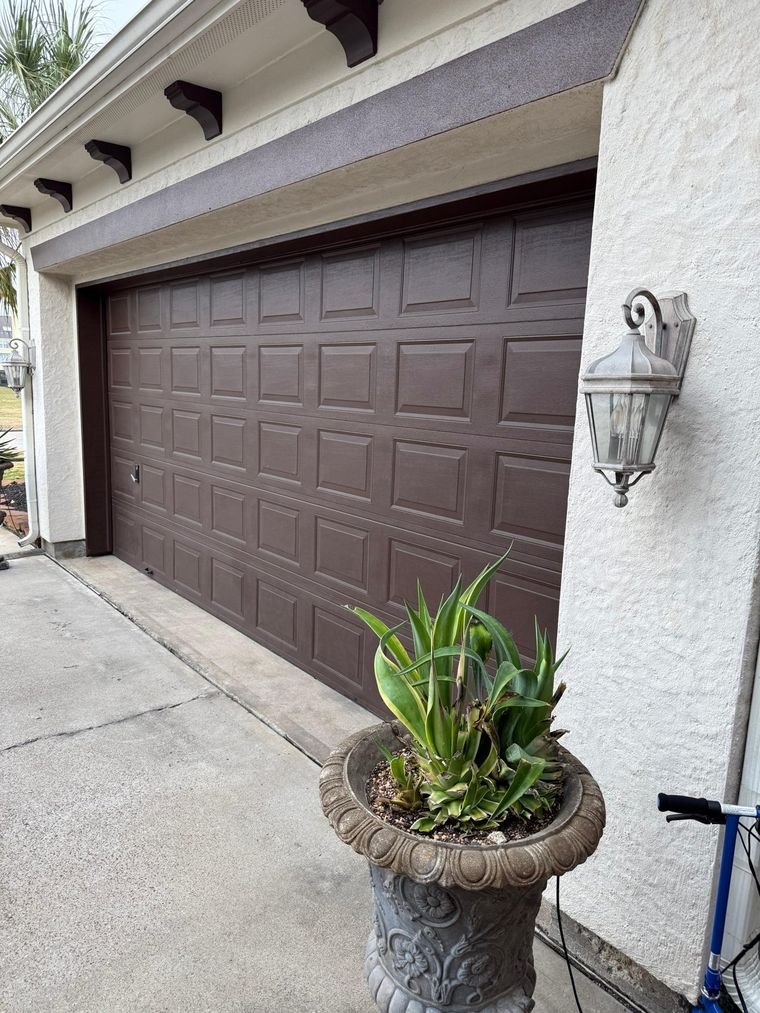
New doors on new track, with the counterbalance sized to the door that actually went in.
Most doors we are called out to replace do not need replacing — and we will tell you that before you spend anything. When one genuinely is finished, here is how to tell, what a single panel might do instead, and what actually happens on the day.
This is the section a company selling doors would leave out. Every one of these gets quoted as a new door somewhere in this metro, and every one of them is a repair on a door that is otherwise fine.
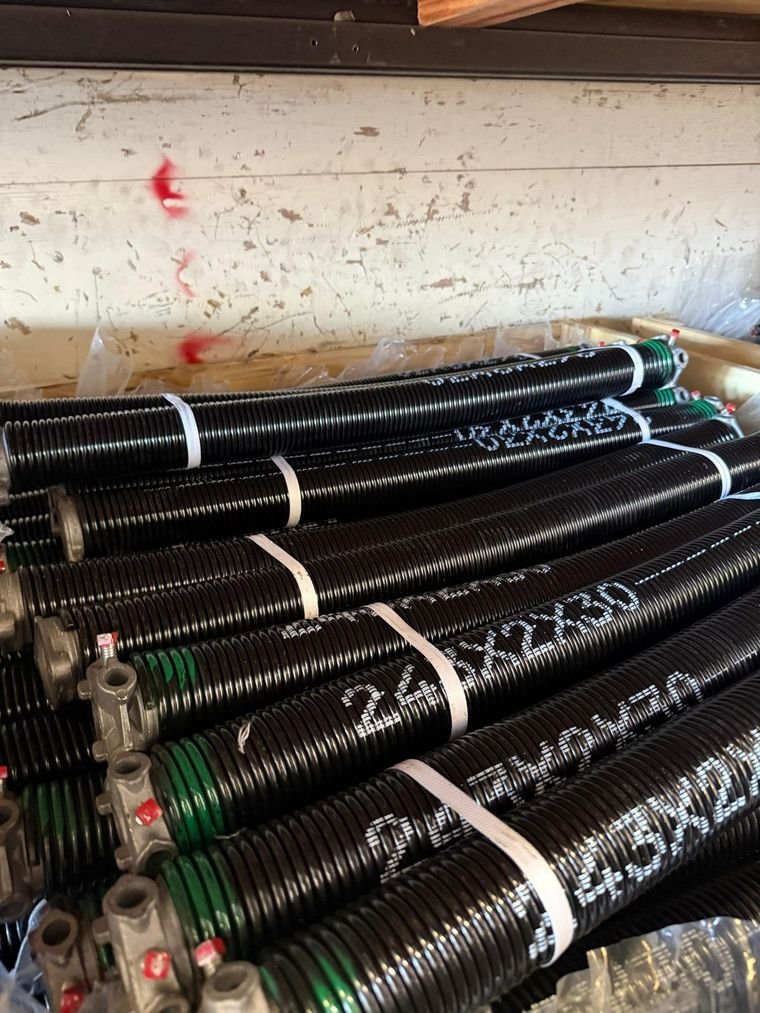
The most common failure there is, and the most commonly upsold. The door is dead weight and the opener cannot lift it, which looks terminal from the driveway. It is a matched pair of springs and an hour on site. Spring repair →
Openers of a certain age fail at the plastic drive gear long before the motor gives up. A gear kit is a fraction of a new unit and a small fraction of a new door. Opener repair →
The door hangs crooked and looks bent out of shape. Nine times in ten the panels are perfectly straight and it is a pair of cables and a drum. Cable repair →
Dramatic to look at, and usually a re-track once whatever caused it is fixed. Only a creased section changes that answer. Off-track repair →
Twenty-year-old steel rollers on exposed bearings make a door sound like it is dying. Sealed nylon rollers and a straightened track transform it for a fraction of a replacement.
The photo eyes six inches off the floor have been knocked out of line by a bike or a bin. Two minutes of realignment, not a fault in the door and certainly not a reason to buy one.
Everything above is about hardware bolted to the door. Replacement becomes the honest recommendation when the problem is the door itself — the panels, the steel, the structure the hardware bolts into. At that point new springs are being fitted to something that cannot hold them properly, and you are paying twice.
| What you have | Repair or replace |
|---|---|
| Rot or rust through the bottom section | Replace. The bottom section is what the hinges and bottom brackets bolt into. Once it has gone there is nothing to fix to. |
| A section creased or folded by an impact | Section or door. Creased steel does not straighten. Whether one panel does it depends on availability — see below. |
| Hairline cracks at the hinge plates | Replace. The door is flexing under its own weight and screws no longer bite. New hardware does not fix a tired panel. |
| A door so old that parts are discontinued | Replace. Not because it is old, but because the next failure has no part behind it. |
| An uninsulated door on an attached garage | Your call. Nothing is broken. This is an upgrade, and a real one if there is a room over the garage. |
| A door that is simply noisy or ugly | Usually repair first. Rollers, hinges and a service fix most noise. Ugly is a genuine reason to replace — just not a mechanical one. |
A sectional door is four or five separate pieces, so a single damaged section can be swapped in principle. Two things decide whether it works in practice.
The first is availability. Door models get discontinued, and a door fitted during the Paulding County building boom is quite likely to be from a range nobody makes any more. If the section does not exist, the decision is made for you.
The second is colour. Ten or fifteen years of Georgia sun fades a painted steel door, evenly and invisibly, until you put a new panel next to it. We would rather warn you about that before fitting it than watch you notice it afterwards. On a door facing away from the street it frequently does not matter at all; on the front of the house it often does.
When a panel does work, it is dramatically cheaper than a door, and we will say so.
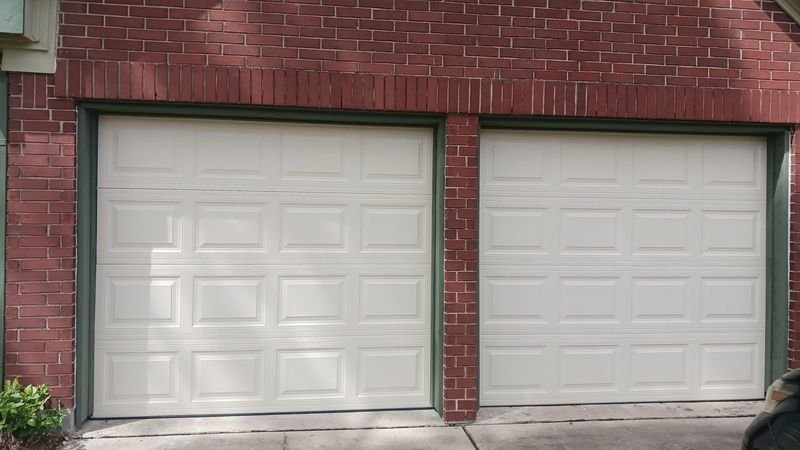
Common on two-car houses around here, and there is no mechanical reason to replace both. It is a question of what the front of your house looks like. A new door next to a fifteen-year-old one is rarely subtle, so the sensible test is whether the second door is also near the end of its life — if it is, doing both in one visit costs less than two visits. If it has years in it, we fit the one and tell you honestly how close the match will be.
The question is always the same: are the sections creased, or just out of the track? A door knocked off its rollers with straight panels is a re-track and a set of rollers, and people are frequently surprised by how cheap that is compared with what they feared.
If a section is folded, it is a section or a door. On the insurance side we can tell you what we see and no more: we provide an itemised written estimate and photographs of the damage, which is what an adjuster asks for. Whether the claim is covered, and under which policy, is between you and your insurer — we are not going to pretend to know that.
It comes down as part of the job. Sections, track, springs, cables and brackets all have to come off before anything new goes up, and the springs come off under control rather than being cut loose. Confirm disposal when you book — whether it leaves with us or stays on the driveway is a question worth a straight answer on the phone.
The full detail on what a new door involves — the door types, the materials, insulation and R-values, and the four measurements that decide what can be fitted at all — is on the garage door installation page. This is the shorter question: what makes one replacement cost more than another.
| Factor | Why it changes the job |
|---|---|
| Panel or whole door | By some distance the biggest single lever, and the first thing worth establishing. |
| Single or double | A 16 ft double is not two singles. More door, heavier hardware, longer day. |
| Insulation layers | Single-skin, two-layer and three-layer are three price brackets and three weights of counterbalance. |
| Windows and glazing | Glass sections cost more and add weight, which feeds back into the spring sizing. |
| Carriage-house or overlay finish | Overlays, decorative hardware and non-standard colours sit above a plain raised-panel door. |
| Whether the opener is re-used | A healthy opener is re-hung and re-set as part of the job. A new one fitted at the same time costs less than a second visit. |
| What is behind the stop moulding | Rotten framing or a badly out-of-square opening has to be dealt with before a new door goes on it. |
Whatever the opening needs, you hear the number before anything is ordered — including the number for the repair, if the repair is the better spend.
Starting with the part most companies skip: finding out whether you need one.
We come out, measure the opening, and give you a straight answer on repair versus replace — including whether a single section will do it. No call-out charge and no obligation.
A firm price covering the door or the panel, the track, the hardware and the fitting. Nothing is ordered until you have approved it.
Sections and track down under control, new track squared to the opening, counterbalance sized to the finished weight of the door, opener re-set, safety reversal tested before we leave.
If you already know you want a new door, or if it turns out to be a repair after all.
The mechanics of a new door: steel, carriage-house and insulated types, R-values, the four measurements, and exactly what a proper install includes.
See installation →The single most common thing mistaken for a dying door. Matched pairs in high-cycle galvanized steel, re-balanced by hand.
See spring repair →The six variables that move any garage door quote, what a fair written estimate states, and five sales tactics worth recognising.
Read the cost guide →New doors on new track, with the counterbalance sized to the door that actually went in.
Send your name, number and what the door is doing — or what hit it. We call back fast, usually within minutes during the day.
The questions we get asked on nearly every replacement estimate across Paulding and Cobb County.
Based at 132 Azalea Lakes Dr in Dallas, GA, with technicians covering Paulding, Cobb, Douglas, Fulton, Cherokee and Bartow County.
The towns in red have a page of their own, with the drive time and the local housing stock — or see every town we cover.
Not on the list? Call and ask — we'll tell you straight away.
One call and we come out, measure properly and give you a straight answer either way — with no call-out charge and no obligation.
Name, number, and what's wrong — we'll call you right back, usually within minutes.