On the Truck
Track Work We Finish Most Days
Rollers, track and the cable hardware that is usually the reason the door came out of it in the first place.
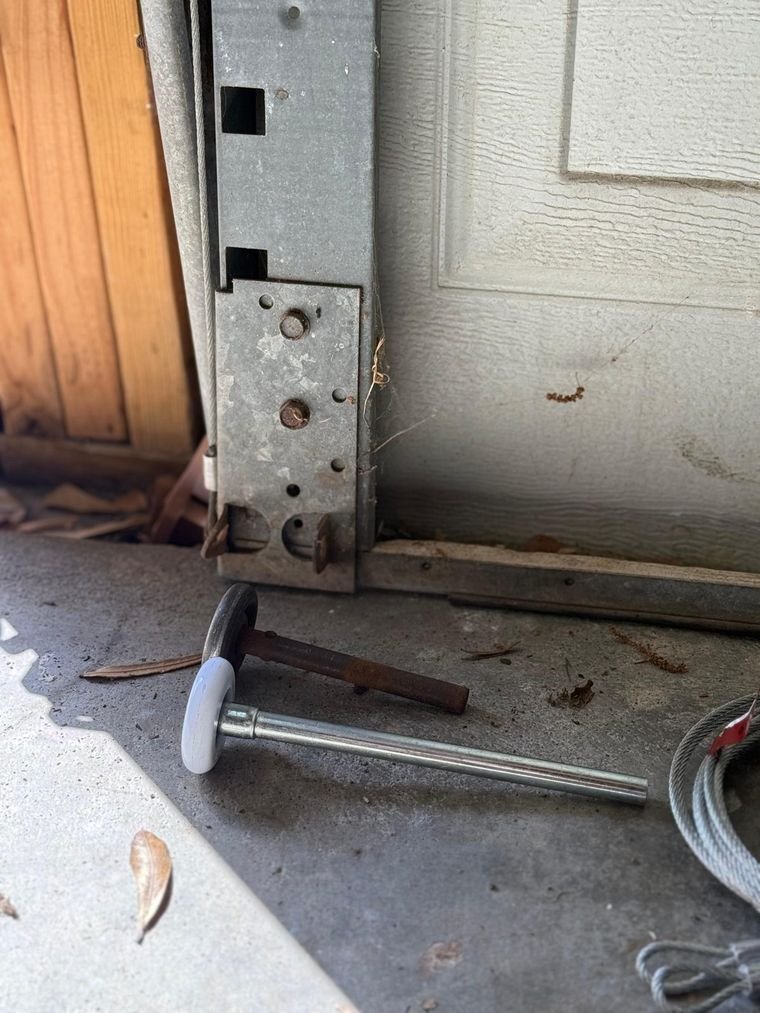
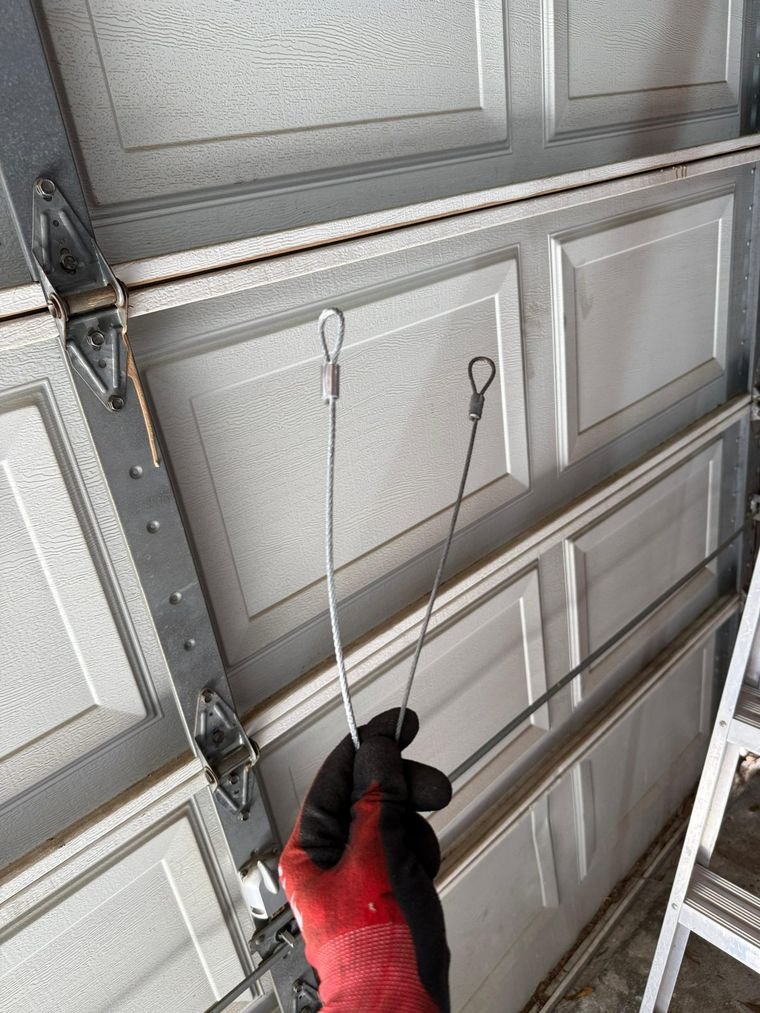
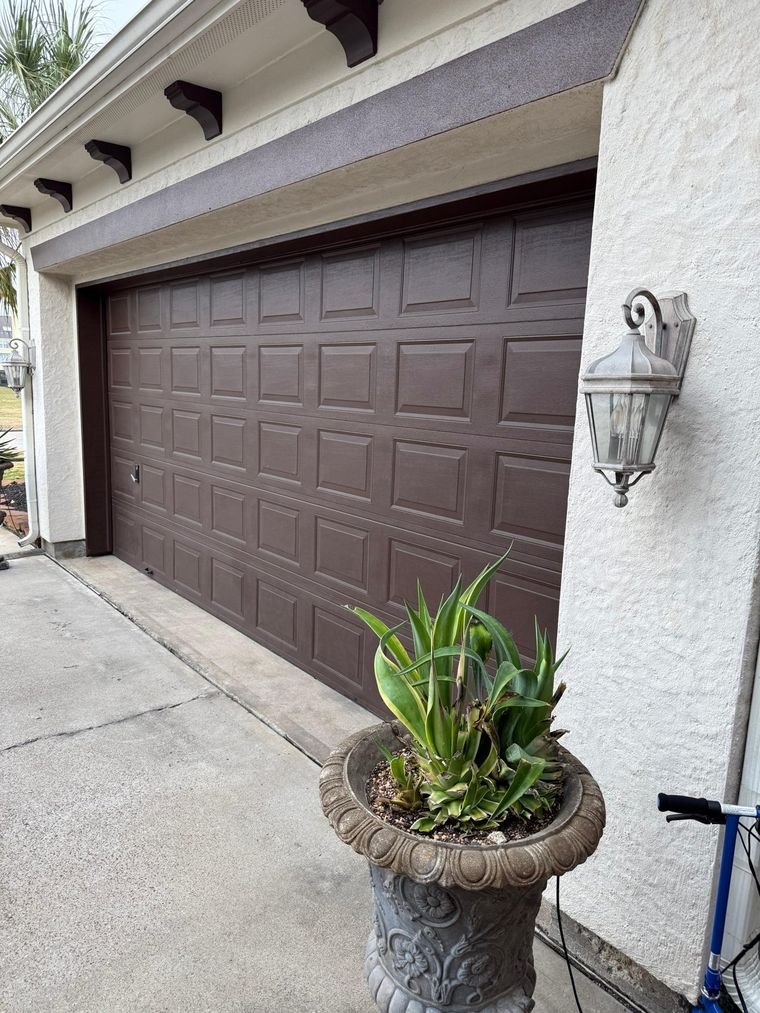
A door hanging at an angle is being held up by whatever is still doing its job. We secure it, control the spring tension, fix what actually caused it and re-track it properly — rather than levering it back in and hoping. Same day, 24 hours a day.
Doors do not come off the track for no reason. Almost every one we are called to is one of these, and which one it is decides what the repair actually involves.
The most common cause by a distance. A bumper into a partly open door pushes a section back and the rollers out with it. What matters next is whether the section is creased or just displaced — a displaced door is a repair, a folded one is a panel.
One side climbs, the other does not, and the door wedges itself across the opening. If there is slack cable on the floor or wound round the shaft, that is the cause and the cable is the actual repair.
Builder-grade steel rollers run on exposed bearings. Twenty years in a humid Georgia garage and one eventually stops rolling, drags, and finally comes apart — usually taking the door out of the track at that corner.
Track is bolted to the framing and the brackets do loosen over the years. A track that has drifted out of alignment lets a roller wander, and a track that has been bent will not hold one at all.
A bin, a bike, a bag of mulch. The door closes onto it, the bottom section stops while the top keeps coming, and the bottom rollers pop out. The photo eyes only see across the opening, not what is sitting to one side of the beam.
A door that had been juddering, catching at one point in its travel, or needing the opener's force turned up was telling you something. Off the track is frequently the last step of a sequence rather than a single event.
A sectional garage door does not hang from anything. It is held in a pair of steel channels by rollers, one at each end of every section, and the whole assembly is counterbalanced by the springs so the opener only has to nudge it. Take one roller out of that channel and the geometry stops working: the door twists, the load goes diagonally through hinges and brackets that are designed for a straight pull, and the next thing to give is whatever is weakest.
That is the real reason for the warning above. The damage from an off-track door is almost never done by the original event. It is done in the next five minutes, by someone pressing the remote twice more to see if it will sort itself out, or shoving the door sideways with a crowbar. A door that came off cleanly is usually a straightforward morning's work. The same door after ten minutes of persuasion can need a section, a length of track and a set of brackets.
| What happened | What it usually needs |
|---|---|
| Vehicle impact, section not creased | Re-track, new rollers at that corner, check and re-align the track |
| Vehicle impact, section creased or folded | Section replacement on a recent door, or a new door if the model is discontinued |
| Broken or jumped lift cable | New cables in pairs, drums re-set even, then re-track and re-balance |
| Broken spring, door dropped | Springs in matched pairs first — the re-track is the second half of that job |
| Worn or shattered roller | Full set of sealed nylon rollers, hinges checked, track re-aligned |
| Loose, drifted or bent track | Re-anchor and re-align, or replace the damaged length outright |
| Closed onto an obstruction | Re-track, then check the photo eyes and re-set the opener's down force |
We will not hammer a kinked track back into shape and call it aligned, and we will not put a creased section back up because it is cheaper on the day. Both come back, and the second visit is always worse than the first. If your door needs a panel or a length of track, we would rather tell you that at the quote than discover it for you later.
The flip side is that we also will not quote you a whole new door for something that is genuinely a re-track. Most off-track doors we see are repairs, and a repair is what we will recommend when it is the right answer.
Getting the rollers back in the channel is the visible part and the quickest part. Here is what a technician actually does on site, and why the rest of the list is what stops the door doing it again next month.
An off-track repair is priced on what the door actually needs, not on an hourly meter. We quote free over the phone once you describe it, and on site you get a flat, written price before any work begins — the visit and the diagnosis are free whether or not you go ahead. These are the things that move the number:
| Factor | Why it changes the job |
|---|---|
| What caused it | A roller is a small job. A snapped cable is a cable job plus a re-track. A broken spring is a spring job plus a re-track. |
| Whether a section is damaged | Straight sections go back up. A creased one needs replacing, and availability depends on the door's age and model. |
| Track condition | Re-aligning and re-anchoring is routine. A bent or kinked length has to be replaced rather than straightened. |
| Door size and weight | A 16 ft insulated double is more door to support, square up and re-balance than an 8 ft single. |
| How far it was forced | A door that was pushed, levered or run repeatedly after coming off usually needs more than one that was left alone. |
| Time of day | Emergency and overnight dispatch is available 24 hours; a scheduled daytime visit is the cheaper option if the door can safely wait. |
Whatever the door needs, you hear the number before we start — including if getting to it shows that the track came off second and a cable or a spring came first.
Most off-track calls across Dallas, GA and the surrounding metro are handled the same day you ring.
Which corner is out, whether anything hit it, whether there is slack cable on the floor, and whether the door is up or down. That is usually enough for a free phone quote and for the right parts to be on the truck.
An in-house technician, not a call-centre subcontractor, arriving with rollers, cables, hinges, brackets and springs already on board.
You approve a written price before anything is touched, including if a section or a length of track turns out to be needed. The door is re-balanced by hand and safety-tested before we leave.
The track is where the problem shows up. It is rarely where the problem started.
One cable pulling and one not is the classic way a door wedges itself across the opening. If there is slack cable on the floor, start here.
See cable repair →A spring letting go drops the door and puts the whole load somewhere it does not belong. The re-track is the second half of that job.
See spring repair →Car shut in behind a jammed door, or a door stuck open overnight leaving the house unsecured? We're open 24 hours and a real person answers.
See emergency service →Rollers, track and the cable hardware that is usually the reason the door came out of it in the first place.
Send your name, number and which corner is out of the track. We call back fast — usually within minutes during the day.
The questions we get asked on nearly every off-track call across Paulding and Cobb County.
Based at 132 Azalea Lakes Dr in Dallas, GA, with technicians covering Paulding, Cobb, Douglas, Fulton, Cherokee and Bartow County.
The towns in red have a page of their own, with the drive time and the local housing stock — or see every town we cover.
Not on the list? Call and ask — we'll tell you straight away.
One call and a local technician is on the way with rollers, cables, brackets and springs already on the truck. Same-day service across metro Atlanta, 24 hours a day.
Name, number, and what's wrong — we'll call you right back, usually within minutes.